
What the transition means for advertisers, what’s changing with Google Display campaigns, and how businesses can prepare for the switchover
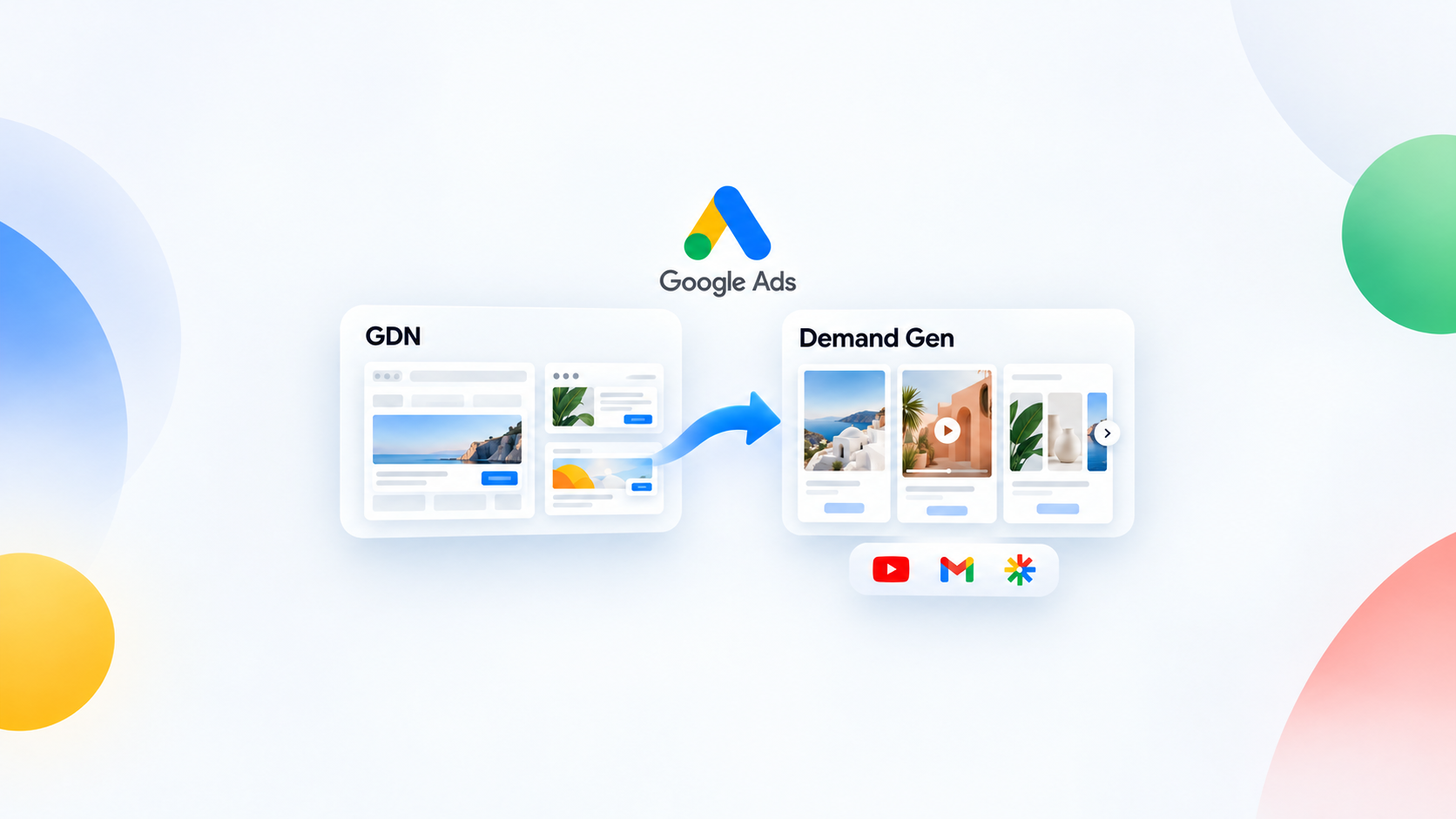
Google Ads is preparing for a significant change to the way advertisers manage display campaigns. During 2027, Google plans to complete the transition away from standalone Google Display (GDN) campaigns, bringing GDN advertising into its Demand Gen (GDG) campaign framework.
For businesses that rely on display advertising for remarketing, brand awareness and audience reach, this is an important development to understand.
The good news? The Google Display Network isn't disappearing. Instead, the way advertisers access and manage it is changing.
For digital marketing teams, this presents both an opportunity to reach audiences across more Google properties and a challenge to review existing campaign strategies, targeting settings and performance expectations before the transition takes place.
For the past two decades, advertisers have been able to create standalone GDN campaigns within the Google Ads platform. These campaigns allow businesses to serve mainly image-based advertisements across a network of millions of websites and apps, supporting objectives such as brand awareness, remarketing and customer acquisition.
Google is now bringing this functionality into GDG, its campaign type designed to generate interest and drive action across Google's visual advertising channels.
Under the new structure, advertisers will be able to access GDN inventory within Demand Gen campaigns, alongside other options in the Google “ecosystem” such as YouTube, Discover and Gmail, with Google Maps also available in beta.
Google announced the transition in May 2026, with the migration expected to be completed during 2027. The rollout is phased, and advertisers should monitor their Google Ads accounts for the latest eligibility information and migration dates. Based on past big migrations, we wouldn’t be surprised if these dates were pushed out further to give folks more time to adjust.
Importantly, this isn't simply a change of name. It represents a broader shift towards a more unified, AI-driven approach to visual advertising, with additional campaign capabilities and a different set of controls.
Google's move reflects its wider strategy of simplifying campaign management while giving advertisers more opportunities to reach potential customers across its advertising ecosystem.
Rather than managing separate campaign types for different visual placements, Demand Gen brings multiple channels together under one campaign framework.
There are three main reasons behind the change.
Demand Gen allows advertisers to reach audiences across multiple Google properties from a single campaign. Businesses can continue to use the GDN while potentially expanding their reach to YouTube, Discover and other supported placements.
This creates opportunities to connect with customers at different stages of the buying journey, from initial discovery to consideration and conversion.
Demand Gen uses Google's machine-learning capabilities to help optimise campaigns towards specific marketing objectives. Advertisers can benefit from automated bidding, audience expansion and creative optimisation, depending on their campaign configuration.
The aim is to make it easier to identify and reach users likely to take meaningful action, rather than relying exclusively on manually configured targeting and individual placements.
Demand Gen supports a wider range of creative approaches, including image, video and carousel formats, alongside audience features such as lookalike segments.
For advertisers prepared to test new approaches, this creates opportunities to move beyond traditional banner advertising and explore more engaging ways to attract potential customers.
However, the additional capabilities don't mean every existing Display campaign should automatically expand to every available channel. Campaign objectives, audience intent and placement quality will remain critical considerations.
The transition will affect advertisers differently depending on how they currently use Google Display campaigns.
For some businesses, the change may create opportunities to improve campaign performance and diversify their advertising activity. For others, particularly those relying on tightly controlled remarketing or specific display placements, the transition will require more careful planning.
Here are the key areas to review.
Audience targeting is one of the most important considerations when migrating existing campaigns.
Advertisers using remarketing lists, Customer Match data, custom segments or contextual targeting should review how their existing audience strategies will translate into Demand Gen.
Google recommends retaining comparable audience approaches during migration to help maintain continuity. Once the transition is complete, advertisers can test additional options, such as lookalike segments, to explore opportunities for audience expansion.
Our recommendation is to avoid making multiple targeting changes at the same time as migrating campaigns. Establish a reliable baseline first, then test new audiences in a controlled way.
Placement management deserves particular attention.
Many advertisers use the Google Display Network to reach users on carefully selected websites and apps. Others rely on placement exclusions (aka negative placements) to prevent ads from appearing alongside unsuitable content or on low-quality inventory.
Demand Gen supports placement exclusions and reporting through the "Where ads showed" report. However, not every legacy setting transfers directly, and some content suitability exclusions are supported only at account level.
Before migrating, advertisers should audit their current placement exclusions, content suitability settings and brand-safety requirements.
After migration, these controls should be checked again rather than assumed to have transferred exactly as before.
Demand Gen supports several familiar automated bidding strategies, including Maximise Clicks, Maximise Conversions, Target CPA and Target ROAS.
However, some legacy bidding options aren't supported in the same way. For example, Manual CPC isn't available as a Demand Gen bidding strategy, although Target CPC is supported.
Businesses using manual bidding or more specialised bid adjustments should review their existing setup and identify an appropriate alternative before migrating.
Although Demand Gen offers channel-level reporting and placement insights, the reporting environment and campaign structure will differ from standalone Display campaigns.
This makes it particularly important to establish a clear performance baseline before migration.
Record historic spend, impressions, clicks, conversions, CPA and ROAS where applicable. Document the audiences, creative formats and exclusions being used so that performance can be compared meaningfully after the change.
Advertisers should also expect some fluctuations in delivery and results during the initial adjustment period. Google advises monitoring migrated campaigns over the first several days.
The best approach is to treat this as a campaign optimisation project rather than an administrative change.
Taking the time to review your account now can reduce disruption, protect valuable campaign learnings and help your team identify opportunities to improve performance.
Here are five steps we recommend.
Identify all active Display campaigns, their objectives, budgets, bidding strategies, audience settings, creative formats and placement exclusions. Prioritise campaigns that generate meaningful business results or account for a significant proportion of your advertising spend.
Check which settings and features will transfer to Demand Gen and which require adjustments. Pay particular attention to bidding, audience configuration, content exclusions, dynamic feeds and ad formats. HTML5 and third-party ad support have been subject to evolving availability, so check Google's current documentation before making migration decisions.
Google recommends using its in-platform migration tool for eligible campaigns. The tool can transfer campaign settings and recent performance learnings, including data from the preceding 42 days, helping to reduce the learning period compared with starting a completely new campaign.
Migration is not reversible, so review the campaign configuration and any compatibility warnings before proceeding. Google's rollout and eligibility rules may vary by account.
Track delivery, spend, conversions, and other key metrics against your pre-migration baseline. Check that budgets, audiences, exclusions and creative assets are configured correctly.
Allow for short-term fluctuations, but investigate any sustained deterioration rather than assuming performance will recover automatically.
Once your core Display activity is stable, consider testing additional Demand Gen placements, video creative or lookalike audiences.
Where possible, use controlled experiments and clear success criteria to determine whether broader reach improves incremental performance. Avoid expanding into additional channels simply because the functionality is available.
Not necessarily.
Google has begun rolling out its migration tool, allowing eligible advertisers to transition existing campaigns ahead of the wider change.
Waiting until the final stages of the rollout could leave less time to identify compatibility issues, review performance and make adjustments before any automatic migration takes place.
Equally, migrating every campaign immediately without reviewing its configuration is not a sensible approach.
The right timing will depend on campaign complexity, business priorities, available resources and the features being used. A phased migration, starting with suitable campaigns and allowing time for evaluation, is a practical way to manage the transition.
For businesses with substantial Display budgets or complex remarketing strategies, an early audit is particularly valuable.
The move from standalone Google Display campaigns to GDN within Demand Gen is part of a wider shift in Google Ads towards integrated, AI-powered campaign management.
For advertisers, the transition offers opportunities to access additional channels, experiment with new creative formats and make greater use of automated optimisation. However, it also introduces changes to familiar campaign settings, bidding options and workflows that need to be understood before migration.
The most successful advertisers will be those who combine the benefits of automation with disciplined campaign management, robust measurement and ongoing performance analysis.
Need help preparing your Google Ads account for the transition?
Our team can help you audit your existing Display campaigns, identify potential migration issues, review your targeting and bidding strategies, and develop a transition plan designed to protect performance while identifying opportunities for growth.
Get in touch to discuss your Google Ads strategy and make sure your campaigns are ready for the changes ahead.